ISO 9001 CERTIFICATE
ISO 9001:2008 Quality Management System, is an internationally accepted management system that meets the expectations and needs of its customers in every process, from the production or service delivery of a product to the place it reaches to the customer, and prioritizes the necessity of all these processes and customer satisfaction
 It is an effective system that can be applied to any sector operating in the Product/Service sector, regardless of type, size, product/service type.
In companies that own ISO 9001:2008 standard, offers the following opportunities; reducing costs, increasing the overall effectiveness of their management and organization, designing more reliable products, reducing scrap/reprocessing and customer complaints, improving productivity, improving the company's quality culture, creating more satisfaction and quality awareness, making business processes more effective, increasing the reliability of the business towards customers, and improving the image and reputation of the company that is necessary for being successful in foreign sales.
History of ISO 9000 Series
1963 : MIL-Q 9858A (US Military)
1969 : DEF Standards (UK MOD)
1974 : AQAP Defence Standards
1979 : BS 5750 Pt 1,2,&3
1987 : ISO 9000 Serisi
1994 : July - ISO 9000 Revision
2008 : ISO 9001 Revision Year
ISO 9000:2008 Series
Consisted of three standards
ISO 9001:2008 – Quality Management systems - Guide for Performance Development.
ISO 9004:2008 – Kalite Yönetim sistemleri – Performans Geliştirme için Klavuz
ISO 9000:2008 – Quality Management systems - Basics and Dictionary
Benefits in Implementing ISO 9000:2008 Quality Management System
-
To facilitate works to be done right at the first time,
-
To increase the chance of competition,
-
To institutionalize by establishing the management standard of the company,
-
To increase the efficiency and profitability,
-
To adopt a customer-oriented approach,
-
To better understand the expectations of the customers and speak the same language with them,,
-
To display a consistent structure that meets the expectations of the customer in terms of product/service delivery,
-
To expand the market share with the quality of service offered to the customer,
-
To be a constantly developing and improving company,
-
To liberalize works performed within the organization from individuals,
-
To bring a system approach,
-
To enable business processes,
-
To reduce costs caused by mistakes and poor quality work,
-
To provide the necessary memory to access error sources,
-
To help perceiving the mistakes as opportunities for improvement,
-
To create permanent in-house information,
-
To increase realistic decision making ability basing on data,
-
To improve in-house communication,
-
To emphasize leadership in management,
-
To encourage the employees to participate
-
To be able to take the advantage of the commercial advantages brought by the business to obtain a quality certificate having international validity (proving the quality for export via certification)
ISO 9001:2008 Quality Terms
Of Quality: Quality is the sum of the features basing on the ability of a product or service to meet specified or potential needs. (ISO 9001:2008)
The degree to which the set of structural features meet the requirements.
It is availability.(Dr.J.M.JURAN)
It is conformance.(P.B.CROSBY)
Quality Policy: It is the statement that shows the orientation and total targets of the company being formally formulated by the senior management in relation to quality.
Quality Management: The activities coordinated for the management and control of an organization.
Quality Targets: What is desired or intended in relation to quality
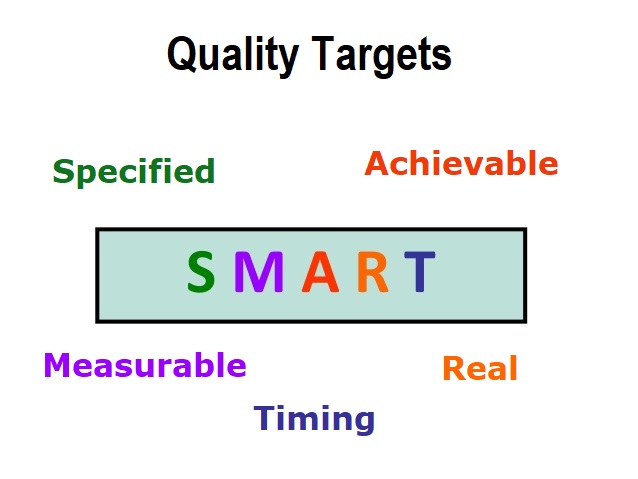
Quality Targets SMART
S : Specified / for a certain, relevant department and process
M: Measurable
A : Achievable
R : Real
T : Timing
Quality Planning: It is a focused part of Quality Management in providing the operational process and relevant sources required for determining the quality targets and meeting these targets.
Quality Control: It is a Part of quality management focused on meeting the quality requirements.
Quality Assurance: It is a part of quality management focused on assuring that quality requirements are met.
Improvement: It is a part of quality management focused on enhancing the organization's ability to meet quality requirements.
Working Environment: Conditions of the working place.
Audit Criteria: The policy, procedure and requirements that have been set as reference.
Product: A Result of the Process (Note: Four General Product Categories)
-
Hardware
-
Software
-
Services
-
Processed Materials or combination thereof.
Conditions: Determined, Generally requested or legal requirements and expectations. The product may be related to the system or customer. The determined conditions are the ones that are written. The conditions may have been put forward by different sources.
Corrective Action: The activity to eliminate and prevent the recurrence of the root cause of a determined nonconformity.
Preventive Action: The activity to eliminate the cause of a potential nonconformity (not revealed yet).
Non-Standard Permission: Granting exit permission to products that do not meet the requirements.
Release: The permission to continue with the next stage of the process.
Review: The activities performed to determine the conformity and effectiveness of the issues set to achieve the determined targets.
Verification: The confirmation process basing on objective evidence that the specified conditions are met.
Validation: Confirming that the requirements in relation to the required objective and practice are met as a result of the real evidence review.
Real Evidence: The information or data that shows that something has been found and is real.
Nonconformity: Failure to comply with requirements
Process: A series of activities that convert inputs into outputs and that relate or interact with each other
Productivity: The relation between the result obtained and the resources used.